Four changes matter for a small business website in late 2026. Nearly all Indian web traffic is on phones, and Google measures how fast a page responds to taps. Google now answers many questions with AI, in Hindi and Marathi as well as English. The DPDP Rules put a deadline on how forms ask for personal data. Most other trends won't change what you should build.
Why is the phone version the real website?
StatCounter recorded 84.21% of page views in India in October 2026 coming from mobile phones, 15.17% from desktops and 0.62% from tablets. That's a share of page views across the sites StatCounter tracks, so your own split may differ. Check it in your analytics, but expect it to look similar.
Google treats the phone version as the page. Its documentation says it uses the mobile version of a site's content for indexing and ranking, and that only content shown on the mobile site is used for indexing. A price list that only appears on desktop, or a service hidden behind a tab that never loads on a phone, doesn't count for search.
For a business owner this means you approve the design on your phone, not on the laptop the developer shows you. Our post on mobile-first design goes through what changes in layout and forms.
What is INP, and why should you care?
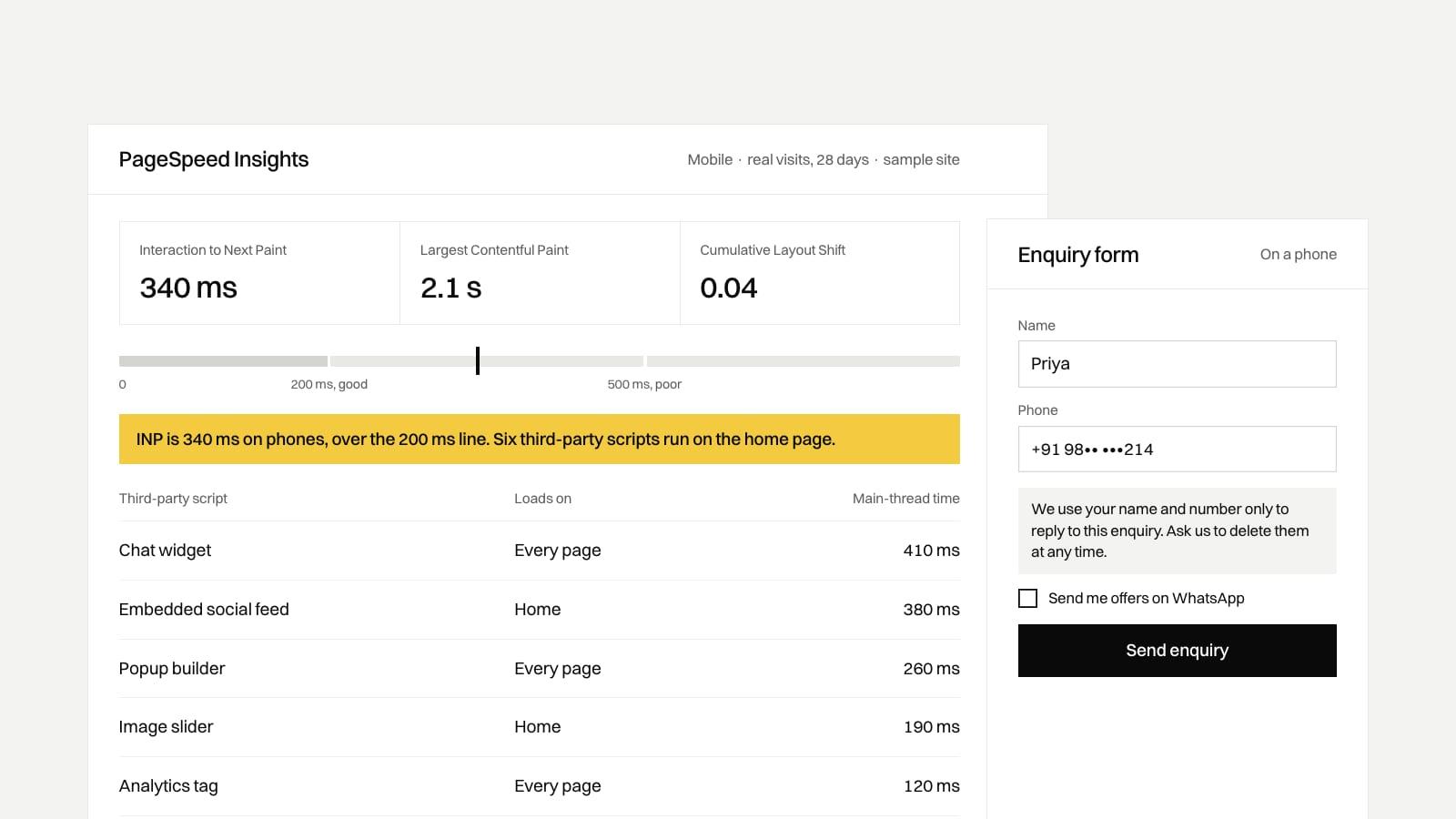
Interaction to Next Paint, or INP, measures how quickly a page responds after someone taps or types. It replaced First Input Delay as one of Google's Core Web Vitals on 12 March 2024. Google's web.dev guide calls an INP of 200 milliseconds or less good and anything over 500 milliseconds poor, measured at the 75th percentile of real visits, with phones and desktops counted separately.
The usual causes of a poor score on a small business site are scripts added one at a time over the years: a chat widget, two analytics tags, a popup builder, an embedded social feed, a slider. Each one runs on the visitor's phone, and a cheap Android phone has much less processing power than the laptop the site was tested on. So the trend that matters is shipping less JavaScript. Remove what nobody uses before buying anything new.
Check your own score in PageSpeed Insights. The field data at the top comes from real Chrome users, and the lab score under it is a single simulated test. A small site may not have enough visits for field data, and then the lab score is all you have.
What do Google's AI answers change?
Google began rolling out AI Mode to everyone in India in English in July 2025. Hindi followed in September 2025, and in October 2025 Google added Bengali, Kannada, Malayalam, Marathi, Tamil, Telugu and Urdu. Someone in Panvel can now ask a long question in Marathi and get a written answer with links underneath.
Google's own guidance for site owners is short. It says there are no extra requirements and no special optimisations needed to appear in AI Overviews or AI Mode. A page needs to be indexed and eligible to show in Search with a snippet, and the usual practices apply, including making sure structured data matches the visible text on the page.
So be wary of anyone selling an "AI search optimisation" package. What we'd do instead is write pages that answer the questions customers actually ask, in plain sentences, with your real prices, areas and hours on the page as text rather than inside an image.
What do the DPDP Rules mean for a website form?
The government notified the Digital Personal Data Protection Rules in November 2025, with an 18-month phased timeline to comply. By our count, 18 months from November 2025 runs to May 2027, but check the exact dates for each provision in the Rules themselves. The press release says businesses must give standalone, clear and simple consent notices that explain the specific purpose for which personal data is collected. If there is a breach, they must tell the people affected in plain language.
Every enquiry form collects personal data, so every small business site is affected. The practical work is small: a short notice next to each form saying what you'll do with the name and number, no pre-ticked marketing checkbox, and a record of who agreed to what. We're developers, not lawyers, so take the legal reading to someone qualified. The custom CRM cost post covers what the Act means once those enquiries sit in a database.
Which trends can a small business ignore?
Lists of web trends from a couple of years ago still rank in search, and many of their items haven't aged well for a shop or a clinic. We couldn't find a current source showing that Web 3.0 or a blockchain website would help a small Indian business find customers, so we wouldn't spend on either. We also couldn't find a current one that makes voice search a separate job from writing clear pages that answer real questions.
A dark mode is a nice extra that doubles the design and testing work. Heavy motion effects give a cheap phone more work to do on every tap. A progressive web app makes sense when customers use your site every day, like an ordering or booking tool. For a brochure site it adds little.
Our take
If Ravi were rebuilding a small business site this month, it would be designed on a phone first, with almost no third-party scripts. We build in Next.js, which can render pages on the server so the visitor's phone has less work to do. Each service and each common question would get its own page with prices and areas in plain text. The forms would carry a one-line consent notice.
None of that needs a large budget. Our Starter website, up to 5 pages, is ₹25,000*. If you're deciding what to build on, read how to choose a tech stack next.
Where these numbers come from
- India's split of 84.21% mobile, 15.17% desktop and 0.62% tablet page views in October 2026: StatCounter Global Stats, checked 3 November 2026.
- Google indexing and ranking the mobile version: Google Search Central, mobile-first indexing, checked 3 November 2026.
- INP replacing FID on 12 March 2024: web.dev announcement, checked 3 November 2026.
- The 200 and 500 millisecond INP thresholds and the 75th percentile: web.dev guide to INP, checked 3 November 2026.
- AI Mode rolling out in India in English, July 2025: Google India blog, checked 3 November 2026.
- AI Mode in Hindi, September 2025: Google India blog, checked 3 November 2026.
- AI Mode in seven more Indian languages including Marathi, October 2025: Google India blog, checked 3 November 2026.
- No extra requirements for AI Overviews and AI Mode: Google Search Central, AI features and your website, checked 3 November 2026.
- The DPDP Rules, the 18-month timeline, consent notices and breach notices: Press Information Bureau release of 14 November 2025, checked 3 November 2026.