For most small Indian businesses the choice comes down to four options. WordPress suits a site you'll edit and post to yourself. Shopify suits selling products online with a cart. Next.js suits a fast site built to your design that changes now and then. Laravel suits anything with logins, roles and your own business rules. Pick by who edits the site and what it has to do.
What does KodeThat build with?
You should know our bias before you read our advice. Ravi builds front ends in React, Next.js and React Native. Zaid builds back ends in Laravel and Next.js. The four client sites we can name split like this:
- Gausiya Exports, a frozen seafood exporter in Navi Mumbai: a product catalogue and an enquiry form for overseas buyers, in Next.js.
- APS for Humanity, a charity in Ghazipur: programme pages, published reports and donations through Razorpay, in Next.js.
- Sidmark, a laminate surfaces supplier in Mumbai: a catalogue of HPL and LPL products with an enquiry form, in Laravel with jQuery on the front end.
- Tanmoy Nath's portfolio site, in Next.js.
Beyond those, we've built a furniture shopping app in React Native, and CRMs and smaller sites for clients we can't name. None of the sites we can name runs on WordPress or Shopify. What we say about those two below comes from their own documentation and pricing pages, not from builds we can show you.
When is WordPress the right choice?
WordPress runs 39.5% of all websites, and 58.2% of the sites where W3Techs could detect a content management system, according to its survey on 3 November 2026. That share is the main argument for it. With that many sites on it, finding another developer is easy if your first one disappears.
It fits when you or your staff will publish often: a blog, news, events, a menu that changes every week. The editor is familiar, and you don't need a developer to add a page.
The cost is upkeep. WordPress recommends PHP 8.3 or newer, MySQL 8.0 or MariaDB 10.11 or newer, and HTTPS. Core, the theme and every plugin need updates, and every plugin you leave out of date is a risk. Our post on website maintenance costs covers what that work costs each year.
When is Shopify the right choice?
Shopify fits when the site is mainly a shop: many products, a cart, shipping, stock and discount codes, all managed by you without a developer. On Shopify's India pricing page, the Basic plan costs ₹1,499 a month billed yearly, and the price goes up as you move to larger plans.
There's an India-specific catch. Shopify's help centre doesn't list India among the countries where Shopify Payments is available, so an Indian store uses a third-party payment provider such as Razorpay. Shopify's pricing page says third-party transaction fees may apply when you do. On Basic that's 2% of each sale, on top of whatever the payment gateway charges.
You also never own the platform. You pay the monthly fee for as long as the store is open, and moving to another platform later means rebuilding the store.
When is Next.js the right choice?
Next.js fits a site built to your own design that has to load fast on a phone, where the content changes now and then rather than every day. Gausiya Exports is a typical case: a catalogue that buyers browse and an enquiry form, with no shopping cart. When you need payments, a gateway connects to it, as Razorpay does for donations on the APS for Humanity site.
The trade-off is editing. Without a content management system attached, changing text means asking a developer. If you'll publish regularly, ask for a CMS from the start. Our Growth website plan, ₹60,000*, includes blog and CMS integration for that reason. A site like this can also run on low-cost static hosting, which the maintenance post compares.
When is Laravel the right choice?
Laravel is a PHP framework for software that does real work behind the screen: logins with different roles, dashboards, approvals, GST invoices, reports, or syncing with Tally. It's one of the two tools Zaid builds back ends in, and Sidmark runs on it. Our CRM Starter is ₹70,000*, and the custom CRM cost post explains what pushes that number up or down.
Plan for upgrades. Laravel releases a major version about once a year, and each one gets bug fixes for 18 months and security fixes for 2 years. A Laravel app that nobody touches for three years is running on a version with no security fixes. Budget a small upgrade every year or two.
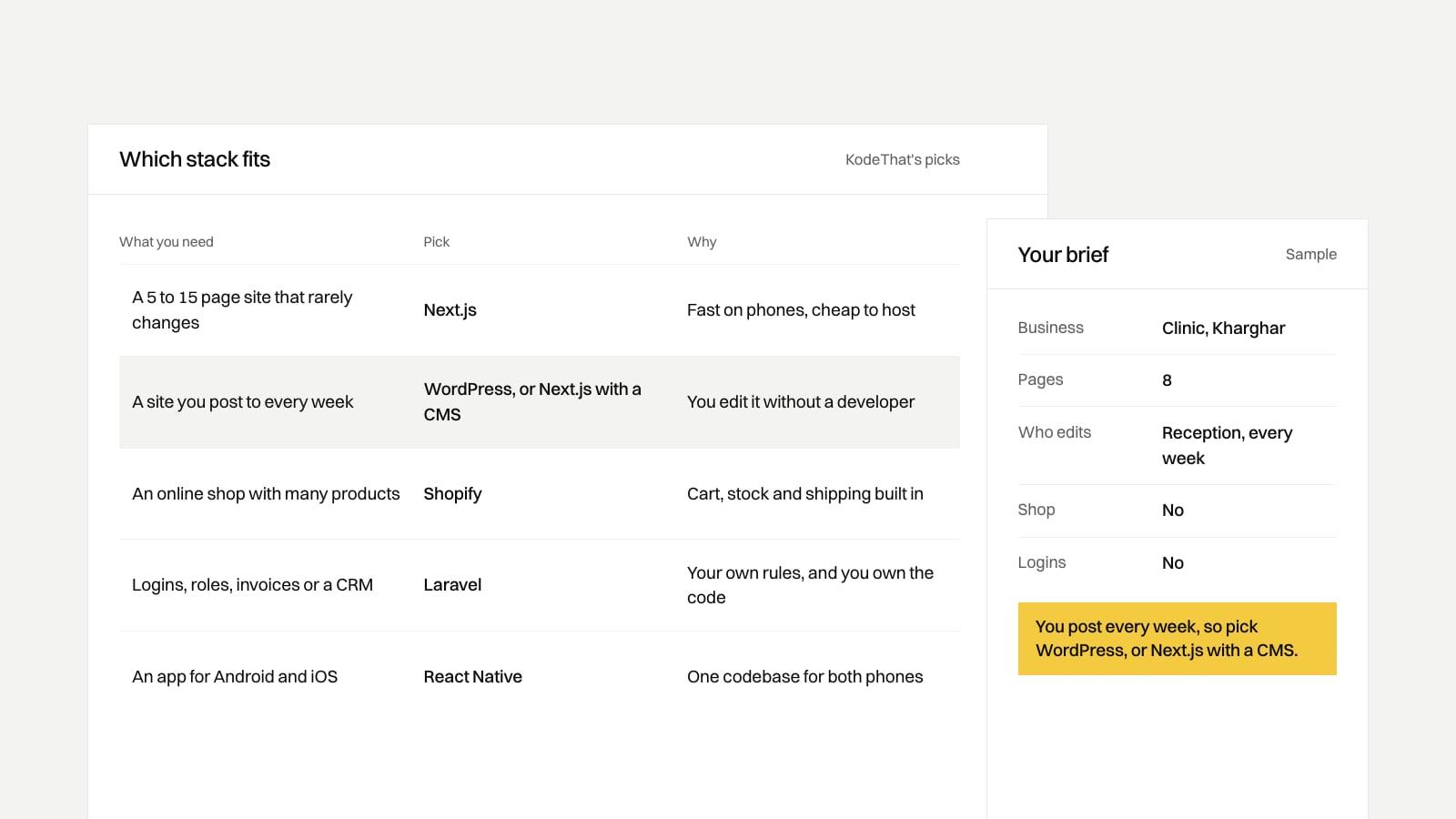
Which one fits your business?
| What you need | Our pick | Why |
|---|---|---|
| A 5 to 15 page site that rarely changes | Next.js | Fast on phones, cheap to host, little to patch |
| A site you post to every week | WordPress, or Next.js with a CMS | You edit it yourself without a developer |
| An online shop with many products | Shopify | Cart, stock and shipping come built in |
| Logins, roles, invoices or a CRM | Laravel | Your own business rules, and you own the code |
| An app for Android and iOS | React Native | One codebase for both phones |
What about MERN, LAMP and Jamstack?
Those are developers' names for bundles of tools. MERN is MongoDB, Express, React and Node.js. LAMP is Linux, Apache, MySQL and PHP, and WordPress and Laravel often run on it. Jamstack means pages built ahead of time and served as files, which is how a static Next.js site works. You don't need to choose between them. Ask any developer, us included, five questions instead:
- What will I be able to change myself, and what needs you?
- Where will it be hosted, and what will it cost to run each year?
- What needs updating, and how often?
- If you stop working with me, can another developer take it over easily?
- Do I own the code, the domain and the hosting account?
Our take
Zaid and Ravi would put most Navi Mumbai shops, clinics and service businesses on Next.js: a small site that loads fast, costs little to host and has almost nothing to patch. If you'll post every week, add a CMS or use WordPress and accept the plugin upkeep. If you sell a lot of products online and have no developer on call, Shopify is the sensible choice despite the fees. Laravel comes in when the site has to run part of your business, such as orders, invoices or approvals.
Avoid building custom software for something Shopify or WordPress already does well. It costs more and gets you little. If you're not sure which side of that line you're on, our custom software page has what we build and how to start.
Where these numbers come from
- WordPress at 39.5% of all websites and 58.2% of sites with a known CMS: W3Techs, usage of content management systems, checked 3 November 2026.
- WordPress's recommended PHP, MySQL and MariaDB versions: WordPress.org requirements, checked 3 November 2026.
- Shopify Basic's India price and the 2% third-party transaction fee: Shopify India pricing, checked 3 November 2026.
- India not listed for Shopify Payments: Shopify Help Center, Shopify Payments supported countries, checked 3 November 2026.
- Laravel's yearly releases, 18 months of bug fixes and 2 years of security fixes: Laravel release notes, support policy, checked 3 November 2026.