A restaurant or cloud kitchen in Navi Mumbai joins ONDC through a seller app such as magicpin. You don't sign up with ONDC itself. You need an FSSAI licence or registration, a GST or PAN number, a bank account and a typed menu. magicpin advertises free registration. The fee you then pay on each order is set by the seller app, and most seller apps don't publish it.
How does ONDC work for a restaurant?
ONDC, the Open Network for Digital Commerce, is a network that apps plug into, and there is no ONDC app for customers to download. Customers order from a buyer app. Your menu sits in a seller app. ONDC passes the order from one to the other, and a delivery company on the same network picks up the food.
ONDC's own description of the seller app's job is to connect sellers to the network, put their catalogue online, pay them out and train them on order handling. The seller app is the company you deal with: it holds your menu, takes your documents and sends you your money. Some big chains, such as McDonald's and Jubilant Foodworks, run their own seller apps for their own outlets. A single outlet in Kharghar or Vashi uses someone else's.
On the buyer side, ONDC's participant list on 3 November 2026 showed these apps live for food, among others: magicpin, Waayu, Digihaat, Kiko Live and CSC Grameen eStore. Many older articles name Paytm and PhonePe's Pincode as the big ONDC food apps. PhonePe shut the Pincode consumer app in December 2025. On the same ONDC list, Paytm's only live category was gift cards, not food.
Which seller apps take restaurants?
These organisations were listed as seller apps for food and beverages on ONDC's participant list when we checked it on 3 November 2026:
- magicpin, which is also a buyer app, so your menu can show up in its own customer app.
- Waayu, a Mumbai food delivery app, also listed as a buyer app. A November 2024 Inc42 report said it charges restaurants a subscription instead of a commission and had restaurants in Navi Mumbai.
- Kiko Live, Shiprocket, Pidge, Adloggs, Tipplr, Dailybee, SellerSetu, MP2 Innovations, Hashtag Loyalty (thrivenow) and CSC Grameen eStore.
The list doesn't say which cities each one serves, so ask before you sign. Restaurant software companies such as uEngage also sell ONDC listing. uEngage isn't on ONDC's list under its own name, so ask which registered seller app your orders would run through.
What documents does a restaurant need?
- An FSSAI licence or registration for the kitchen's address. You apply on FSSAI's FoSCoS portal, and your turnover decides which one you need. Since 1 April 2026, an FSSAI order makes the seller app responsible for the accuracy of the licence details buyers see. The order also says the seller app must sign an agreement with you confirming you follow food safety law. Expect your seller app to check the number.
- A GST number, or a PAN if you have no GST registration. magicpin's partner page asks for "GST / PAN number". Zomato's restaurant terms ask for PAN, GSTIN and FSSAI papers, so you probably have these already if you sell there.
- A bank account in the business's name, for payouts.
- Your menu, with item names, prices and descriptions, and dish photos if you have them.
On GST, the app collects it on food ordered through it. Restaurant service through an e-commerce operator falls under section 9(5) of the CGST Act, which makes the operator pay the tax. On ONDC more than one app touches each order. In uEngage's worked example, the seller app pays the GST, so ask your seller app which one files it and ask for its monthly statement. Your CA will want that statement to match your payouts in Tally.
What are the steps?
Get the papers in one name
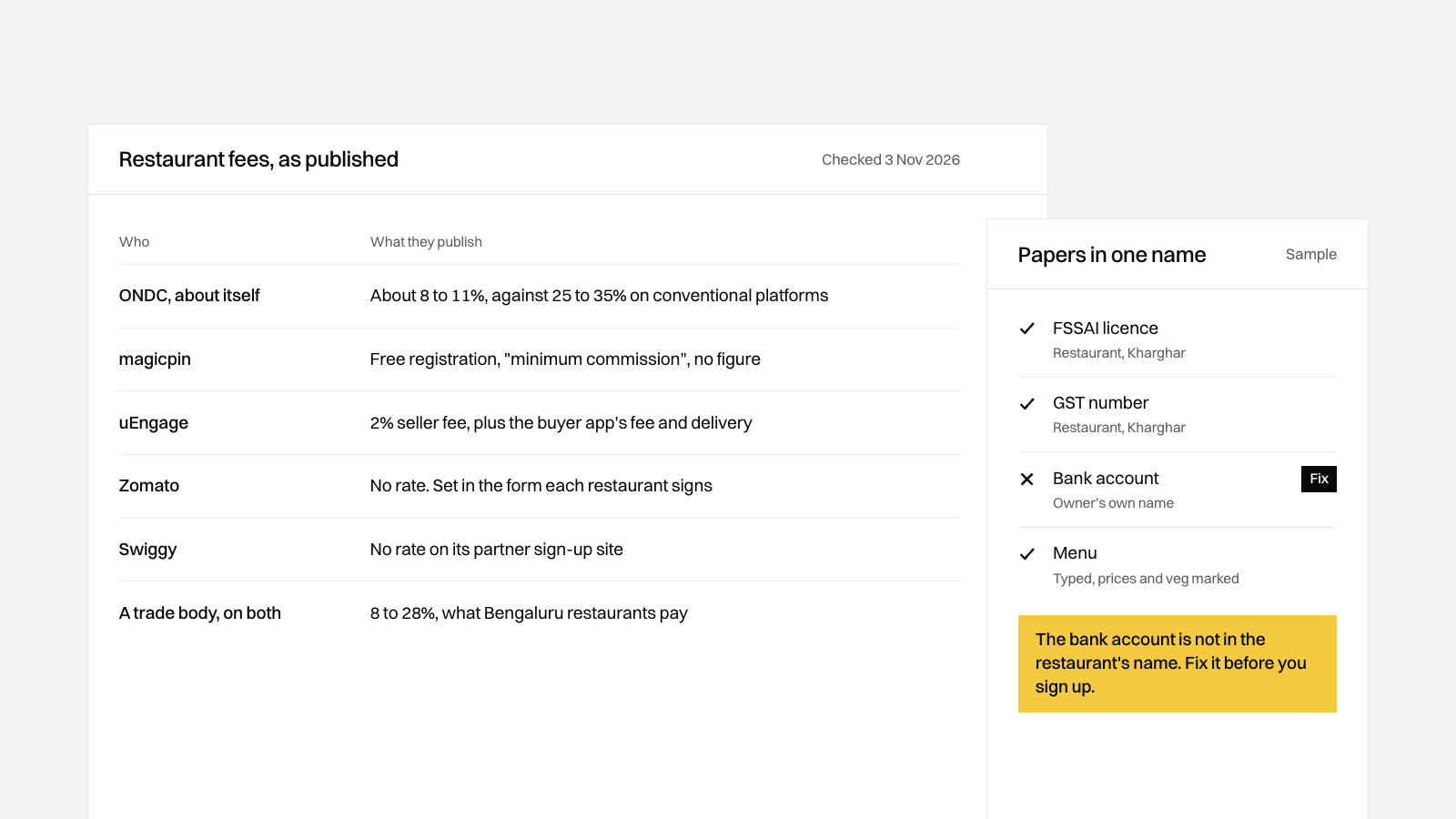
Check that the business name and address match across your FSSAI document, GST or PAN and bank account before you start. Fix any mismatch first.
Type out the menu
Write each item with its price, a one-line description, and whether it is veg. Settle packing charges now. This takes longer than the sign-up.
Pick one seller app and ask four questions
What do you take per order? Who delivers, and who pays for it? How often do you pay out? Which buyer apps will show my menu in Navi Mumbai? Get the answers in writing.
Sign up and finish KYC
Upload the documents, sign the seller agreement and add the menu. magicpin says you can go live in under five minutes, once your menu is typed.
Set the delivery side
Set your delivery radius, preparation time and opening hours, so orders don't arrive after you close.
Place a test order
Order from your own outlet on a buyer app and check the payout line for that order before you tell customers you are on ONDC.
What does ONDC cost compared with Zomato and Swiggy?
None of these companies publishes a full rate card for restaurants, so treat any single number with care.
| Who | What they publish | What it measures |
|---|---|---|
| ONDC, about itself | About 8 to 11% on ONDC, against about 25 to 35% on conventional platforms | ONDC's own claim on its food page. It doesn't say what is included |
| magicpin | Free registration and "minimum commission", with no figure | Its partner sign-up page |
| uEngage | A 2% seller fee, plus each buyer app's own fee and delivery | Its own blog, December 2025. Its buyer app examples were Paytm and Pincode |
| Zomato | No rate. The service fee is "as set out in the Form" each restaurant signs | Its online ordering terms, last updated 19 September 2025 |
| Swiggy | No rate on its partner sign-up site | What we found, 3 November 2026 |
| Zomato and Swiggy, per a trade body | 8 to 28% | What Bengaluru restaurants pay, per the Bruhat Bengaluru Hotels Association president, July 2026 |
Don't subtract one row from another. ONDC's figure is a marketing claim about the whole network. The Bengaluru range is one association's statement about its members' contracts. uEngage's 2% is only the seller app's share, and its page is older than Pincode's closure. On ONDC an order can carry three charges: the seller app's fee, the buyer app's fee and delivery. Ask the seller app to show you one sample order with every deduction on its own line, from what the customer paid to what reaches your bank.
Who delivers ONDC orders?
Delivery companies join ONDC as logistics providers. ONDC's hyperlocal logistics page says it has more than 75 of them in more than 150 cities. It says an order is sent once to every connected fleet, and the nearest riders are quoted on time and cost. The page names Ola, Uber, Shiprocket, Loadshare and Delhivery among them. Shadowfax, Porter and Borzo are on the participant list as logistics providers too. Your seller app usually books the rider for you. In uEngage's example, the customer pays the delivery charge and uEngage pays the delivery company.
ONDC's food page claims an average delivery time of about 31 minutes and about 89% of deliveries on time. Those are ONDC's network-wide figures. We haven't seen any figures for Navi Mumbai, so the test order in step 6 is your real measure.
What can you do yourself, and what do we add?
If your FSSAI papers are in order and your menu is already typed up, you can do this yourself through magicpin's free registration or another seller app from ONDC's list. We'd expect an owner who is comfortable with online forms to finish in an afternoon, without us.
Our ONDC store setup plan, ONDC Launchpad, is ₹25,000* one-time. It covers the seller registration and paperwork, building the menu catalogue, pricing, delivery and payment settings, a WhatsApp storefront so regulars can order from you directly, and training your staff on handling orders. The full list of what we set up for restaurants, including QR menus and websites, is on our page for restaurants in Navi Mumbai. Every plan is on the pricing page.
We don't yet have a restaurant ONDC launch we can show you, and we have no order data from any ONDC buyer app in Navi Mumbai. Everything here about fees and delivery comes from the published sources listed at the end.
Our take: who should bother with ONDC now?
Ravi and Zaid would put a cloud kitchen or a delivery-heavy restaurant on ONDC now, as an extra channel while it stays on Zomato and Swiggy. The papers are the ones you already hold for those apps, registration on magicpin is free, and the per-order fee only applies once orders arrive, so the main cost of trying is your time.
We would start with one seller app, and magicpin is where we would look first. It is on ONDC's list as both a seller app and a buyer app, so your menu can appear in magicpin's own customer app as well as on other buyer apps. Give it 60 days. Then compare two numbers against your aggregator orders: orders per week, and the amount that reached your bank per order. If ONDC orders are a trickle, you have lost an afternoon. If they are steady, add a second seller app.
A dine-in restaurant that does little delivery should skip ONDC for now. We think a well-kept Google Business Profile and a website that shows up for "restaurants near me" will do more for it first. Our post on why a business needs a website and a Google listing covers that, and website development cost in India covers the price.
Pay for help only if your menu isn't typed up yet, nobody on your team has time to do this, or you want customers ordering directly on WhatsApp as well. Orders that come to you directly on WhatsApp pay no commission to any app.
Where these numbers come from
- ONDC's claimed commission range, the 31 minute average delivery time and the on-time rate: ONDC's food and beverages page, checked 3 November 2026.
- Seller apps and buyer apps live for food, Paytm's live category, and logistics providers on the network: the participant list on ONDC's network participants page, checked 3 November 2026.
- What a seller app does, and the two seller node types: ONDC's seller network participants page, checked 3 November 2026.
- The count of logistics providers and cities, and how riders are assigned: ONDC's hyperlocal logistics page, checked 3 November 2026.
- magicpin's documents, free registration, "minimum commission" and five-minute go-live claim: magicpin's partner page, checked 3 November 2026.
- uEngage's 2% seller fee, buyer app fees and delivery example: uEngage's ONDC seller app post, published 30 December 2025, checked 3 November 2026.
- The seller app's FSSAI duties from 1 April 2026: FSSAI order on e-commerce food businesses in the ONDC model, dated 18 March 2026, checked 3 November 2026. Licence applications: FoSCoS.
- Zomato's service fee being set in each restaurant's form, and its document list: Zomato's online ordering terms, last updated 19 September 2025, checked 3 November 2026.
- The 8 to 28% range: Free Press Journal report on Bengaluru restaurants, updated 30 July 2026, checked 3 November 2026.
- GST on restaurant service through apps: Circular 167/23/2021-GST, as issued by Himachal Pradesh's tax department, dated 5 January 2022, checked 3 November 2026.
- Pincode's closure: TechCrunch, 5 December 2025, checked 3 November 2026.
- Waayu's subscription model and Navi Mumbai restaurants: Inc42, 28 November 2024, checked 3 November 2026.
- The ONDC Launchpad price and what it covers: our pricing page.