Start on Zoho CRM, or a tool like it, if a handful of people use it and your sales stages look like most other businesses'. Move to a custom CRM when your team spends part of every day working around the software: keeping a spreadsheet beside it, typing token amounts into the notes field, or running follow-ups from a WhatsApp group the CRM can't see.
This post is about telling those two situations apart. What a custom build costs, and how that compares with Zoho over three years, is in our post on custom CRM development cost in India. What we build for real estate, clinics and coaching institutes is on the CRM development page for Navi Mumbai.
What does Zoho CRM already do for a small team?
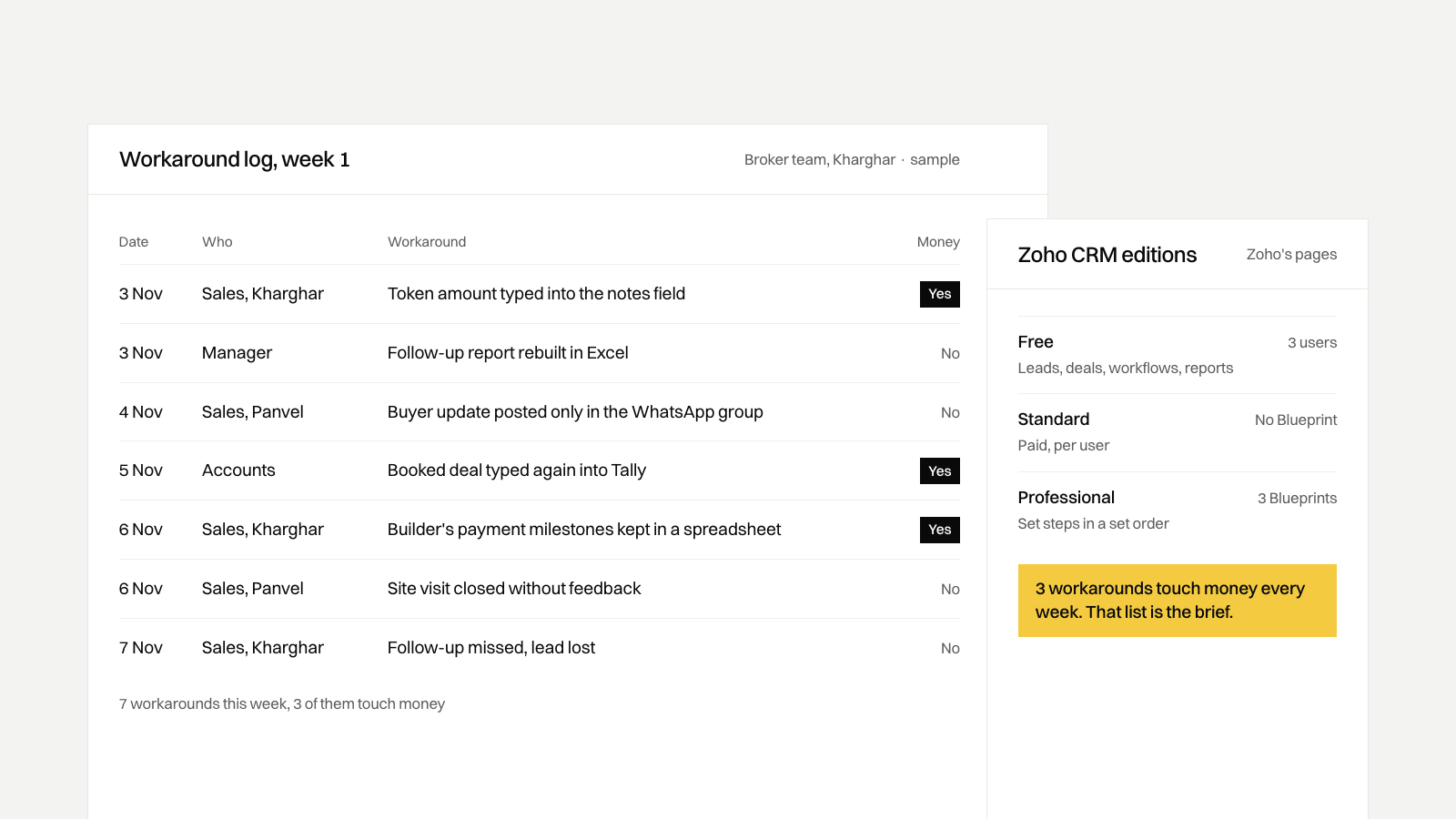
Zoho's pricing page says its free edition stays free for 3 users and includes leads, deals, workflows, reports and a mobile app. The paid editions add more. Blueprint, Zoho's tool for making a deal pass through set steps in a set order, isn't in the Free or Standard editions; Professional includes 3 Blueprints. Zoho also connects to WhatsApp Business, and its comparison page notes that sending WhatsApp messages needs credits.
We took those details from Zoho's own pages on 3 November 2026. We haven't tested each edition's limits ourselves, so check the comparison page against your own list before you buy.
When will a subscription CRM do the job?
- Your pipeline is a normal one. Enquiry, call, meeting, quote, won or lost. Every CRM is built around that shape, and Zoho will fit it on day one.
- Three to five people use it. At that size the free or Standard edition costs less than any build, and the cost post shows the sums.
- You're still changing how you sell. Changing a stage in Zoho takes a few clicks. In a custom CRM it's a paid change, so a process that changes every month is cheaper to run on a subscription.
- Nobody on your side will own the system. A custom CRM needs one person who decides what changes and talks to the developers. Without that person, Zoho's support desk is the safer bet.
What are the signs your team needs a custom CRM?
Your records don't fit leads, contacts and deals
A property broker in Kharghar or Panvel tracks a flat as well as a buyer: which buyers saw it, who paid a token, what the builder's payment milestones are. A coaching institute tracks a student, a parent, a batch and fee instalments. You can force these into a generic CRM with custom fields, but the team ends up keeping the real picture in Excel.
Some steps have to happen, every time
"No deal moves to booked until the token is recorded." "A site visit can't be closed without the agent's feedback." In Zoho, rules like these need Blueprint, which starts at the Professional edition. If your rules go further than Blueprint handles, or you'd pay for Professional mainly for that one feature, a custom build starts to make sense.
The selling happens on WhatsApp
In Navi Mumbai most customer conversations happen on WhatsApp, and the CRM only hears about them later, if at all. A custom CRM can put the chat on the lead's record and send the follow-up when the stage changes. Zoho can send WhatsApp messages too, through its integration and credits. Either way, Meta charges for the messages your business sends, as our post on WhatsApp Business API pricing explains.
Tally or another office system is at the centre
If your accountant lives in Tally and every closed deal has to become an invoice there, someone is typing it twice today. A custom CRM can be built around that hand-off. Tally usually runs on a computer in your office, so the sync is its own piece of work with its own testing.
Management wants numbers no dashboard shows
Follow-ups done on time per agent, site visits per lead source, fees overdue by batch. If your manager rebuilds the same report in Excel every Monday, that report belongs in the CRM.
A two-week test before you decide
Ask everyone who touches leads to write down each workaround for two weeks. Count the spreadsheet kept beside the CRM, the field used for something it wasn't meant for, the WhatsApp group where updates really happen, and the report rebuilt by hand. Also note the times a lead was lost because a follow-up was missed.
If the list is short, or most items are settings you haven't found yet, set Zoho up properly and stop there. If the same few items come up every day and they touch money, like token amounts, fee instalments or invoices, that list is the brief for a custom CRM. Bring it to the first call and the quote will be far more accurate.
What changes when you own the CRM?
You own the code, and the database sits on a server you control, so you can export everything whenever you like. Every change after launch is work someone has to do, and the server needs backups and security updates. With Zoho, the vendor does that work and the data sits on Zoho's servers under Zoho's terms. Either way, the names and phone numbers in your CRM are personal data under the Digital Personal Data Protection Act, and your business answers for them. The cost post covers what that means for a build.
We've built CRMs for clients we can't name yet, so we can't show them here. What we build, and how we hand it over, is on the CRM development service page.
Our take
Sayed Zaid builds the server side of our CRMs and Ravinder Kumar builds the screens. Our advice to a small Navi Mumbai business: start on Zoho's free or Standard edition and run it for six months. Come to us when the two-week list keeps showing the same problems and at least one of them involves money or WhatsApp. By then you know your own process well enough to write it down, and a custom CRM built from that list fits on the first try. If your list turns out to be settings in Zoho, we'll say so on the call.
Where these numbers come from
- Zoho CRM's free edition for 3 users and what it includes: Zoho CRM pricing, checked 3 November 2026.
- Blueprint not in Free or Standard, 3 Blueprints in Professional, and WhatsApp messages needing credits: Zoho CRM edition comparison, checked 3 November 2026.