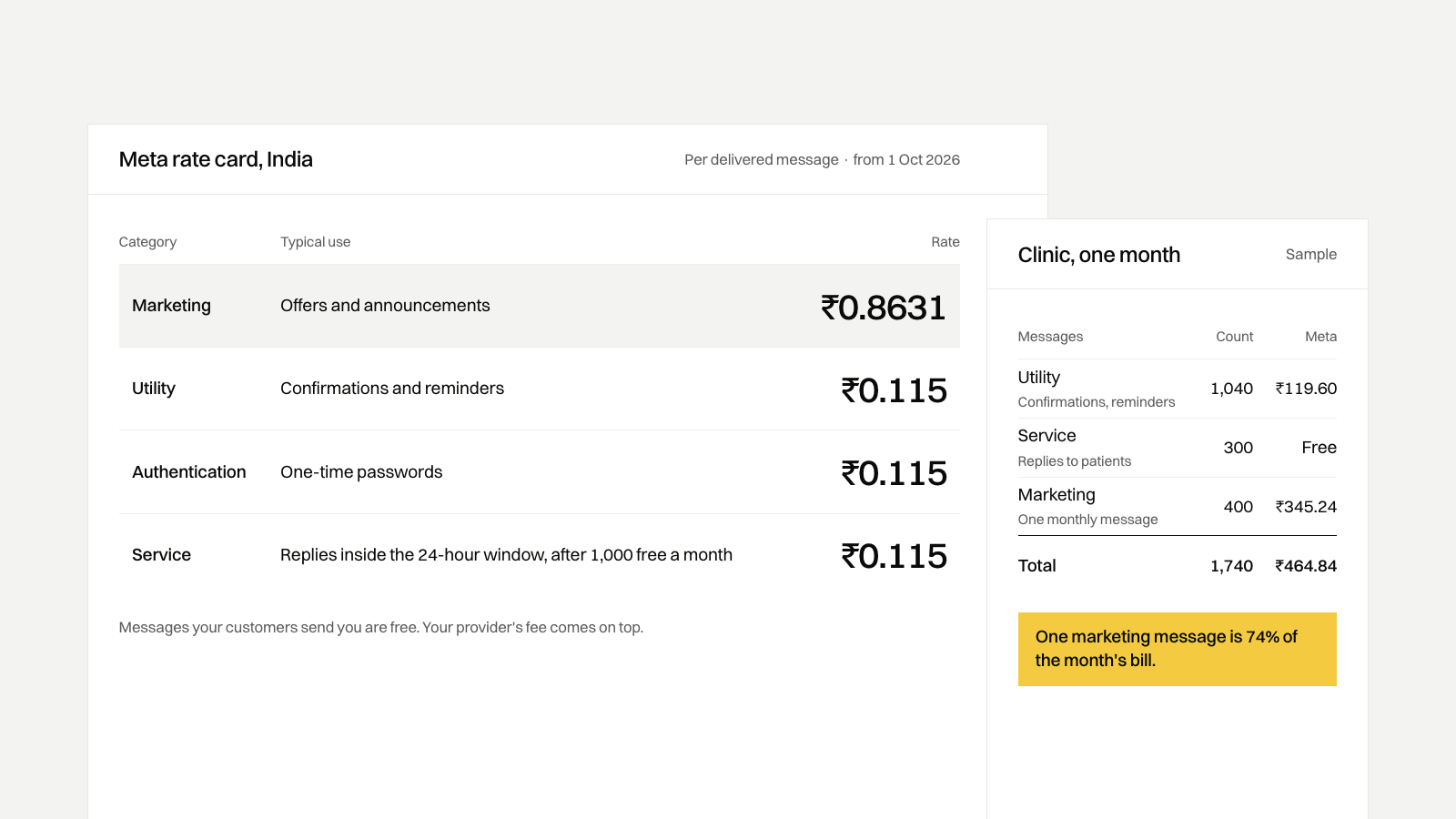
In November 2026, Meta charges an Indian business for each template message it delivers to an Indian number. A marketing message costs ₹0.8631. A utility or authentication message costs ₹0.115, per Meta's INR rate card effective 1 October 2026. Replies inside the 24-hour customer service window cost the same, after 1,000 free ones a month per number. Your provider's fee comes on top.
How does Meta charge for WhatsApp messages in India?
Since 1 July 2025 the WhatsApp Business Platform has charged per delivered message. The old per-conversation model is gone. The rate depends on two things: the message category and the country code of the person receiving it. A patient on a +91 number is billed at the India rate, whatever language the message is in. Messages your customers send you cost nothing.
Meta has four categories that matter to a small business.
- Marketing templates are for promotion: offers, festive greetings, a check-up camp. You can send them at any time.
- Utility templates are transactional, such as a booking confirmation or an appointment reminder.
- Authentication templates carry one-time passwords.
- Service messages are free-form replies. You can only send them inside the customer service window, which opens when a customer messages you and lasts 24 hours from their latest message. Outside that window you can only send templates.
There is a fifth category, Meta Business Agent, for replies written by Meta's own AI. It is billed per token in US dollars, at $2.00 per million tokens. Meta's documentation says replies from a third-party AI or from a person count as service messages, so a chatbot built on another AI model is billed at the service rate.
Utility and authentication messages also have volume tiers, which lower the rate as your monthly count grows. Meta sets the thresholds. The list rate is the first tier, so it is the most you pay for those messages.
What are Meta's India rates right now?
These are the India rates from Meta's INR list rates file, effective 1 October 2026, which we checked on 3 November 2026. Each one is per delivered message.
| Category | Rate per delivered message | Typical use |
|---|---|---|
| Marketing | ₹0.8631 | Offers and announcements |
| Utility | ₹0.115 | Confirmations and reminders |
| Authentication | ₹0.115 | One-time passwords |
| Service | ₹0.115 after the first 1,000 each month | Replies inside the 24-hour window |
Meta also publishes the same card in US dollars, but it now wants Indian businesses billed in rupees. Eligible accounts must move to INR billing by 31 December 2026, and from 1 January 2027 Meta stops delivering messages from their non-INR accounts.
India's marketing rate went up on 1 January 2026. Meta's pricing calendar says it can only change rates on the first day of a quarter, with at least a month's notice, so 1 January 2027 is the next date anything could change.
What is still free?
- Every message a customer sends you.
- The first 1,000 service messages each month, for each business phone number. Unused ones don't roll over.
- Everything you send in a free entry point window. If a customer taps a Click to WhatsApp ad on their phone and you reply within 24 hours, Meta opens a window of up to 7 days in which marketing, utility, authentication and service messages are all free.
Two things changed on 1 October 2026, and older articles still describe the earlier rules. Service messages, which Meta had made free, are charged again past the 1,000 free tier. Utility templates sent inside an open customer service window, free since 1 July 2025, are charged too. WhatsApp's own marketing page for platform pricing still said service messages were free when we checked it on 3 November 2026. We have gone with the developer documentation, because it carries the dated rate card.
If your Meta account has no payment method, Meta delivers service messages within the free 1,000 and then stops delivering them.
What does a WhatsApp provider add on top?
Most small businesses reach the API through a Business Solution Provider, which Meta's documentation calls a Solution Provider. Depending on the setup, Meta bills the provider or bills you directly. You can also skip the provider and connect to Meta's Cloud API yourself. Connecting directly needs a developer to build the sending, the inbox and the templates, and that is the work a provider packages.
Providers price in different ways. Some charge a monthly platform fee for their inbox and broadcast tools and pass Meta's rate through unchanged. Others add a markup to each message. We have not compared every provider's pricing, so we won't quote one here. Ask any provider for a quote that lists Meta's per-message charge and their own fee as separate lines. With Meta's rate card next to it, you can see the markup.
Meta's pricing documentation doesn't say how GST applies to these charges, and we couldn't find a Meta or government page that does. Ask your CA, and check the tax lines on the first invoice from Meta or your provider before you budget.
Do you need the API, or is the free app enough?
The WhatsApp Business app is free to download and has no per-message charge. It gives you a business profile, a product catalogue, and greeting and away messages. For a shop or clinic that gets a few dozen chats a day, answered by the owner or the front desk, the app is enough.
You need the API when software has to send or answer messages for you. That covers reminders sent automatically from your booking system, a chatbot that replies at midnight, messages logged in a CRM, and several staff working one number from a shared inbox. Our post on custom CRMs for Navi Mumbai businesses covers the CRM side.
What would a Kharghar clinic pay Meta in a month?
This is an illustration, not a real client's bill. We assumed a clinic in Kharghar with these numbers:
- 20 appointments a day, 26 working days a month, so 520 appointments.
- Patients book by phone or at the front desk, so each appointment gets two utility templates: a confirmation when it is booked and a reminder the day before. That is 1,040 utility messages.
- About 300 typed replies a month to patients who write back to reschedule or ask a question. These fall inside the 1,000 free service messages.
- One optional marketing message a month, such as a monsoon check-up reminder, to 400 patients who have opted in.
- Every patient has a +91 number, no message falls in a free entry point window, and every rate is the list rate.
| Messages | Count | Meta charge |
|---|---|---|
| Utility: confirmations and reminders | 1,040 | ₹119.60 |
| Service: replies to patients | 300 | Free, inside the 1,000 tier |
| Marketing: one monthly message, optional | 400 | ₹345.24 |
| Total with the marketing message | 1,740 | ₹464.84 |
The totals are Meta's charges only, before GST and before any provider fee. Reminders are the cheap part of the bill, and the optional marketing message costs nearly three times as much as all the reminders put together. Meta defines marketing templates as ones with a promotional objective, so a reminder that also pushes an offer risks being billed at the marketing rate. Keep reminders to the appointment details.
Patient phone numbers and appointment details are personal data under the Digital Personal Data Protection Act, 2023. Take consent for WhatsApp messages at the front desk and keep a record of it.
How do KodeThat's plans sit on top of Meta's fees?
Our AI chatbot and WhatsApp automation work has two plans. AI Chatbot is ₹30,000* + ₹3,000*/mo. It answers on WhatsApp and your website in English, Hindi and Marathi, captures leads and hands a chat to a person when needed. WhatsApp Automation Pro is ₹60,000* + ₹5,000*/mo and adds lead qualification, appointment booking, follow-up sequences and reminders, CRM and Google Calendar links, and broadcasts to opted-in customers. Both are on the pricing page.
Our service page says the monthly fee covers the WhatsApp Business API, AI usage and ongoing tuning. Neither the service page nor our pricing says whether Meta's per-message charges sit inside that fee. They rise with your volume, so we confirm how they are billed on the free call, with your expected message counts in front of us. The chatbot's replies run on a third-party AI model, so Meta bills them as service messages, which puts most of a small business's bot replies inside the 1,000 free.
Our take for a small Navi Mumbai business
Ravi and Zaid would start a clinic like the one above on the free app, and move to the API once the front desk is sending reminders by hand every evening. In the example, Meta's charge for a month of reminders is small next to any setup cost or provider fee, so the message bill shouldn't decide whether to automate. Those other two costs should.
We would hold off on marketing messages for the first few months. They cost about seven and a half times a utility message, and a clinic's first WhatsApp messages should be ones patients expect. Get the reminders working, then test one broadcast and see who replies.
If you already use the API, check two things this month. Make sure your Meta account has a payment method, or your replies stop after the first 1,000. And ask your provider whether your account has moved to INR billing ahead of the 31 December 2026 deadline.
We haven't measured how much WhatsApp reminders cut no-shows, so we don't quote a figure for it. The clinic numbers are our assumptions, and we couldn't confirm how GST applies to Meta's charges.
Where these numbers come from
- India rates for marketing, utility, authentication and service: the INR list rates file, effective 1 October 2026, linked from the rate cards section of Meta's WhatsApp pricing documentation, checked 3 November 2026.
- Per-message pricing since 1 July 2025, the four categories, the 24-hour window, volume tiers and the Meta Business Agent rate: Meta's WhatsApp pricing documentation, checked 3 November 2026.
- The 1,000 free service messages, the free entry point window, the 1 October 2026 changes and the payment method rule: the same page, sections on when Meta does not charge and on prior updates, checked 3 November 2026.
- INR billing for India and the 31 December 2026 deadline: the billing localization section of Meta's WhatsApp pricing documentation, checked 3 November 2026.
- WhatsApp's consumer-facing description of what is free: WhatsApp Business Platform pricing, checked 3 November 2026.
- The WhatsApp Business app being free to download, with a business profile: WhatsApp's launch post for the app, checked 3 November 2026.
- Greeting and away messages in the app: WhatsApp Business app page, checked 3 November 2026.
- The clinic example: our own arithmetic from the rates above, using the assumptions listed in that section.
- KodeThat plan prices and what the monthly fee covers: our pricing page and service page.